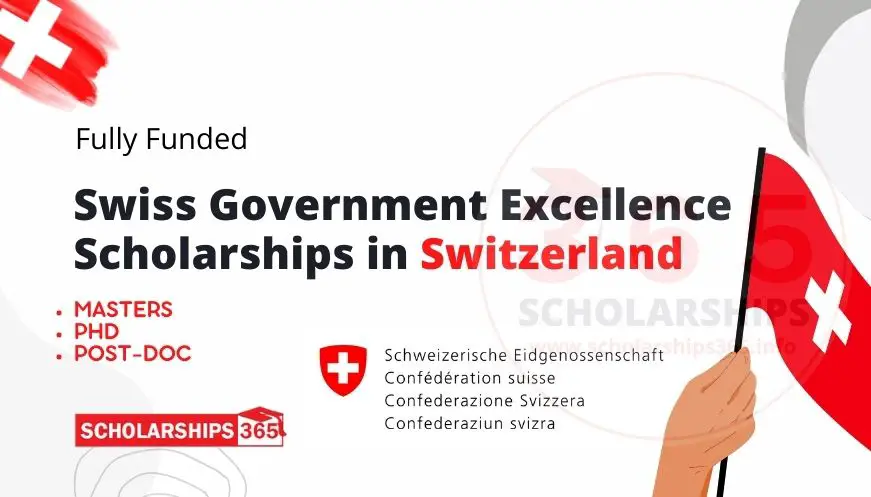
Planning to study in Europe? Applications are now open for the Swiss Government Excellence Scholarships 2027-2028, a fully funded program run by the Swiss Confederation to support international research, doctoral study, and the arts. The scholarship invites talented PhD candidates, postdoctoral researchers, and art students from around the world to pursue advanced study in Switzerland. Each year, the Swiss Confederation awards these scholarships to strengthen academic and cultural ties between Switzerland and more than 180 partner countries. Selected scholars receive a monthly stipend, health insurance, and access to some of the world's top-ranked research institutions, including ETH Zurich and EPFL. Don't miss this opportunity to build your research career while studying in Europe.
Program Overview: What Are the Swiss Government Excellence Scholarships?
The Swiss Government Excellence Scholarships 2027-2028 are a key part of Switzerland's international education, research, and innovation (ERI) strategy. The program funds doctoral / PhD and postdoctoral research, as well as a limited Art Scholarship track for master's-level art students. To apply for the research track, candidates must already hold a master's degree - the scholarship itself does not fund a standalone master's program. It is aimed at highly motivated, independent researchers ready to take on ambitious, self-directed academic work in Switzerland.
The Swiss Confederation awards these scholarships every year to encourage international collaboration and exchange in research and the arts, connecting Switzerland with more than 180 partner countries. They are open to citizens of any country with which Switzerland holds diplomatic relations. Beyond individual funding, the program reinforces Switzerland's standing as a global leader in education, research, and innovation.
Switzerland is consistently ranked among the world's strongest education and research systems, home to top institutions such as ETH Zurich and EPFL. Its universities attract a high proportion of international students and maintain a long track record of investment in research and innovation - a key driver of the country's economic and academic standing. This is why the Swiss Government Excellence Scholarships 2027-2028 actively seek out ambitious, research-driven applicants from around the world.
You may also want to read about the Chevening Scholarship, another leading fully funded government scholarship open to international students.
Beyond funding, the Swiss Government Excellence Scholarship gives recipients direct access to Swiss academic networks, the chance to collaborate with leading researchers, and hands-on experience in Switzerland's research culture. Many scholars stay connected through alumni networks long after their scholarship ends, contributing to ongoing international academic collaboration.
Host Country: Switzerland
Eligible Institutions: Swiss cantonal universities, universities of applied sciences, ETH Zurich, EPFL, and Swiss research institutes
Scholarship Provider: Swiss Confederation (State Secretariat for Education, Research and Innovation - SERI)
Financial Coverage: Fully Funded - monthly stipend, health insurance, housing allowance, and travel benefits
Funded Degree Levels: PhD (Doctoral) and Postdoctoral Research; separate Art Scholarship track for Master's-level art study
Prerequisite: Applicants to the research track must already hold a Master's degree
What Are the Benefits of Swiss Government Excellence Scholarships?
There are two scholarship types under the Swiss Government Excellence Scholarships for international students studying in Switzerland.
Research Scholarships: Open to any field of study. Recipients can conduct research at any Swiss cantonal university, university of applied sciences, either of Switzerland's two federal institutes of technology (ETH Zurich or EPFL), or one of the four ETH-Domain research institutes (PSI, WSL, Empa, Eawag).
Art Scholarships: Open to students pursuing an initial Master's degree in an artistic field in Switzerland. This track is limited to applicants from a specific list of eligible countries. Recipients can study at any Swiss conservatory or university of the arts.
What Do the Swiss Government Excellence Scholarships Cover?
- A monthly stipend of CHF 2,450 for Research and Art scholars.
- No application fee - the process is completely free of charge.
- Swiss health insurance, mandatory for non-EU/EFTA scholars.
- A travel allowance for the return trip home after non-EU/EFTA scholars complete their studies.
- A one-time housing allowance of CHF 600, paid at the start of the scholarship.
- A half-fare card for discounted Swiss public transportation.
- Access to support services and cultural activities organized for scholarship recipients.
Eligibility Criteria for Swiss Government Excellence Scholarships
To qualify, applicants generally need to meet the following requirements:
- Secure a letter of acceptance from a Swiss academic supervisor willing to direct your proposed research - this is a mandatory prerequisite for the Research Scholarship track.
- Hold a Master's degree (or recognized equivalent) before applying to the Research Switzerland Scholarship track, covering PhD and postdoctoral-level research.
- Hold a Bachelor's degree in an artistic field to apply to the Art Scholarship track, which funds an initial Master's-level art program.
- Be a citizen of a country that holds diplomatic relations with Switzerland (183 eligible countries).
- Meet the maximum age limit of 35.
- Be able to relocate to Switzerland for the full duration of the scholarship.
- Not have spent more than one year in Switzerland prior to applying (unverified - confirm against your country-specific page before publishing).
- Not have previously received a Swiss government scholarship.
- Check country-specific eligibility conditions, since exact requirements vary by nationality. Visit the official Swiss Government Excellence Scholarships page and select your country for exact details.
Documents Required for Swiss Government Excellence Scholarships
Applications are submitted entirely online through Grants Online (GO ESKAS) - do not send documents by email or in paper form. You'll typically need to prepare:
- A concise CV, including any publications.
- A motivational letter outlining your research or study goals.
- A research proposal, using the required format, generally no more than 5 pages, prepared with your academic supervisor.
- Academic transcripts and diplomas confirming your completed degree.
- Two letters of recommendation from academic referees.
- A letter of support and CV from your Swiss academic supervisor (Research Scholarship applicants).
- Passport copies and any country-specific supporting documents listed for your nationality.
-
Exact document requirements vary by country - always confirm the full list on the official Grants Online (GO ESKAS) portal before applying.
What Is the Deadline for the Swiss Government Excellence Scholarships 2027-2028?
Applications for the 2027-2028 cycle open on August 20, 2026. There is no single universal deadline - each country has its own submission deadline, published by SBFI once applications open. Applicants should check the official Swiss Government Excellence Scholarships page and select their country of origin for the exact deadline.
Results are announced by the end of May 2027 at the latest, for scholarships starting 1 September 2027.
How to Apply for the Swiss Government Excellence Scholarships 2027-2028
Applications are submitted entirely online - start at the official Swiss Government Excellence Scholarships page, which lists eligibility requirements, country-specific deadlines, and the application portal.
- Check your eligibility - confirm you hold a completed master's degree (or, for the Art Scholarship, a bachelor's degree in an artistic field), and that you meet the maximum age limit of 35.
- Register on Grants Online (GO ESKAS), the official application portal linked from the SBFI page above.
- Find your own academic supervisor at a Swiss university if applying for a Research Scholarship - this step is entirely the applicant's responsibility; neither ESKAS nor the universities will do this for you.
- Target supervisors whose research matches your field. A closely aligned research interest significantly improves your chances of a positive response.
- Reach out directly and professionally. A well-prepared, specific inquiry that clearly states your interest in a Swiss Government Excellence Scholarship gets better results than a generic request.
- Confirm country eligibility first if applying for the Art Scholarship, since this track is open to a limited list of nationalities only.
- Prepare your application in English, including your CV, research proposal, and supporting documents.
- Submit through GO ESKAS by your country's deadline. Never send applications by email or in paper form - check the official page for your country-specific deadline and requirements before submitting.
Tips for a Successful Swiss Government Excellence Scholarship Application
The Swiss Government Excellence Scholarships are highly competitive, with a limited number of places awarded each year across 183 eligible countries. A few things can meaningfully strengthen your application:
Start your supervisor search early. Per SBFI's own guidance, professors at Swiss universities receive a high volume of scholarship inquiries, so a generic email is unlikely to get a response. Research the professor's recent publications, reference specific work of theirs that aligns with your proposed research, and explain clearly why their supervision fits your project.
Make your research proposal specific, not broad. Reviewers assess your application on three criteria: your candidate profile, the quality and originality of your research project, and the potential for future academic cooperation between you and Swiss institutions. A tightly scoped, well-argued proposal outperforms a broad, ambitious-sounding one.
Apply only once you have a genuine supervisor commitment. An acceptance or willingness letter from your Swiss academic supervisor is a mandatory prerequisite for the Research Scholarship track - don't submit before this is secured.
Track your specific country's deadline closely. There is no universal deadline - deadlines are published by SBFI per country, typically between September and December, and late applications are not considered.
Never pay to apply. SBFI has issued an official warning about phishing scams impersonating the Swiss Government scholarship program, often asking for visa or insurance fees. The real application process is completely free - never send money to anyone claiming to process your Swiss Government scholarship.
Common Mistakes to Avoid When Applying
Even strong candidates get rejected over avoidable errors. Based on the official application requirements, here's what trips applicants up most:
- Applying without a confirmed supervisor. For the Research Scholarship track, a willing academic supervisor in Switzerland is a mandatory prerequisite - not a formality you can sort out after submitting. Applications without this confirmed are not considered.
- Assuming postdoctoral scholarships are still funded. Postdoctoral scholarships were discontinued starting with the 2027-2028 cycle. Postdoc-level researchers can still apply, but only under the standard Research Scholarship track, at the same rate and criteria as PhD applicants - not as a separate funded category.
- Missing the age cutoff. The maximum age is 35. Applicants close to this limit should confirm the exact cutoff date for their cycle before investing time in a full application.
- Writing a broad, generic research proposal. Reviewers assess applications on the quality and originality of the research project, not just credentials. A vague or overly ambitious proposal performs worse than a tightly scoped, well-defined one that clearly connects to your chosen supervisor's work.
- Sending a generic email to a potential supervisor. Swiss professors receive a high volume of scholarship inquiries. A mass-sent, non-specific message is unlikely to get a response - successful applicants research the professor's recent work and explain precisely why it fits their proposed project.
- Submitting paper documents or applying by email. The official process is entirely online through Grants Online (GO ESKAS). SBFI explicitly warns against paper or email submissions - using the old process is treated as a non-submission, not just a formatting error.
- Assuming a Master's degree alone qualifies you for general funding. Outside the Art Scholarship track, this program does not fund standalone Master's study. A completed Master's degree is the entry requirement for the Research Scholarship track, not something the scholarship pays for on its own.
- Ignoring your country-specific deadline. There is no universal deadline - deadlines vary by country and late applications are not considered. Confirm your exact date on the official SBFI page as soon as applications open.
- Responding to unofficial scholarship offers. SBFI has issued a formal warning about phishing scams using the Swiss Government's name to request visa or insurance payments. The real application is completely free - treat any request for money as fraudulent.
Related Scholarship Guides
Frequently Asked Questions: Swiss Government Excellence Scholarships
Is the Swiss Government Excellence Scholarship really fully funded?
Yes. Selected scholars receive a monthly stipend of CHF 2,450, mandatory Swiss health insurance (for non-EU/EFTA recipients), a one-time housing allowance, a half-fare travel card, and a return travel allowance after completing their studies. There is also no application fee.
Can I apply for a Master's degree under this scholarship?
Only through the Art Scholarship track, which funds an initial Master's degree in an artistic field for applicants from a limited list of eligible countries. Outside of Art, the scholarship does not fund standalone Master's study - a completed Master's degree is a prerequisite to apply for the Research Scholarship track, not something the scholarship itself funds.
Are postdoctoral scholarships still available?
No. Per the official SBFI announcement, postdoctoral scholarships are no longer awarded starting with the 2027-2028 academic year. Postdoctoral researchers pursuing early-career research may still be eligible under the Research Scholarship track if they meet the age and degree requirements.
Is there an age limit to apply?
Yes. Applicants must be 35 years old or younger, based on the official maximum age criteria for the Research and Art Scholarship tracks.
When do applications open, and what is the deadline?
Applications for the 2027-2028 cycle open on August 20, 2026. There is no single universal deadline - each country has its own deadline, published by SBFI once applications open. Applicants should check the official Swiss Government Excellence Scholarships page for their country's exact date.
How do I apply - is it done online or on paper?
Applications are submitted entirely online through the Grants Online (GO ESKAS) portal. The official SBFI guidance is explicit: do not send applications by email or in paper form.
Do I need to find my own academic supervisor?
Yes. For the Research Scholarship track, applicants must independently identify and contact an academic supervisor at a Swiss university who is willing to guide the proposed research. Neither ESKAS nor the universities assist with this search.
Is this scholarship a scam-prone target?
Applicants should be aware that SBFI has issued an official warning against fraudulent scholarship offers using the Swiss Government's name, typically via email or social media, asking for money under the pretext of visa or insurance costs. The genuine application process is completely free - never send payment to anyone claiming to process a Swiss Government scholarship.

![10 Best Saudi Arabia Scholarships 2026-2027 [Fully Funded]](https://scholarships365.info/images/images-data/10-best-saudi-arabia-scholarships-study-saudi-arabia-fully-funded.png)